History of Art Course Descriptions, Winter 2010
Paris-By-Site (Instructor TBA)
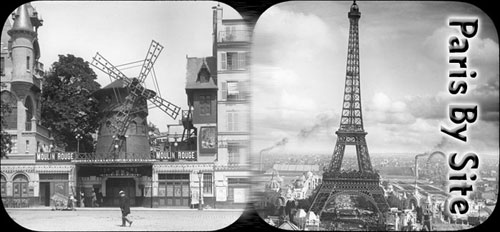
This course is designed as an introduction to the city of Paris (including its principal monuments, edifices, cemeteries, entertainment venues, and commercial centers), as well as to the visual codes that make the city readable through any number of interpretive lenses. It is also designed to familiarize students with the urban landscape in which they will live for a semester, and to make of their daily perambulations an opportunity for ongoing lessons in architectural history, social and cultural geography, urbanization, and city planning.
The course accordingly promotes the incorporation of scholarly work with the educational opportunities that only a direct experience of the city can afford. Weekly topics (taught both on-site and in the classroom) focus on particular aspects of the Parisian landscape in conjunction with interpretive problems they raise. Week after week, the operative objective is to alert students to the historical and material determinants behind the building of Paris, while simultaneously underscoring the changing significance of urban sites through time.
The class will tour Paris's great churches (Notre-Dame, Sainte-Chapelle, Saint-Denis), the catacombs and sewers, the Châteaux at Versailles, the Moulin Rouge, the Opéra, celebrated department stores, and the Père Lachaise cemetery, among other notable sites.
Note: This is a four-credit class that may be applied to concentration/minor requirements in History, French, or History of Art. For concentrators and minors in History of Art, it fulfills the following distributive requirements: Geography→Europe; Time Period→Medieval, or Early Modern, or Modern/Contemporary.
Alchemists of Revolution (Howard Lay)
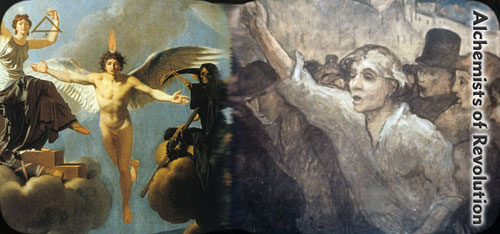
Revolution is a utopian project, and revolutionaries presumably want nothing more than to eradicate the past, to reconfigure the present, and to imagine an egalitarian and harmonious future. One of their most urgent missions is to invent communicative systems that represent the distinctions between revolutionary objectives and the iniquities associated with the past. At the same time, of course, their best efforts to figure revolution are necessarily tied to older systems of representation that are already inflected by the same histories of subjugation they want to overcome. Such was the case when, following the storming of the Bastille in 1789, France embarked on a revolutionary trajectory that lasted—despite intense resistance from reactionary quarters—for a century.
This course addresses the most fundamental problem of French revolutionary rhetoric: how to communicate the promises of a revolutionary future with systems of representation (both visual and verbal) that are necessarily linked to the past. Our focus is on the revolutionary visual forms (in painting, sculpture, photography, and lithography) that emerged in France during the great upheavals of 1789-99, 1830, 1848, and 1871. These are well rehearsed historical paroxysms, and they are among the most memorable of the events around which the French Republic has built its master narratives. But they are also the stuff of revolutionary mythmaking, so our inquiry will also involve an examination of interrelationships between history, memory, and fiction, as well as the rhetorical mechanisms through which the distinctions between them become blurred.
Site visits convene at the Musée du Louvre, the Musée d'Orsay, the Musée Carnavalet, the Musée d'Art et d'Histoire de Saint-Denis, and the Musée national des Arts et Traditions populaires.
Note: this is a three-credit, 300-level course. For concentrators and minors in History of Art, it fulfills the following distributive requirements: Geography→Europe; Time Period→Modern/Contemporary.
Modernism/Modernity (Howard Lay)
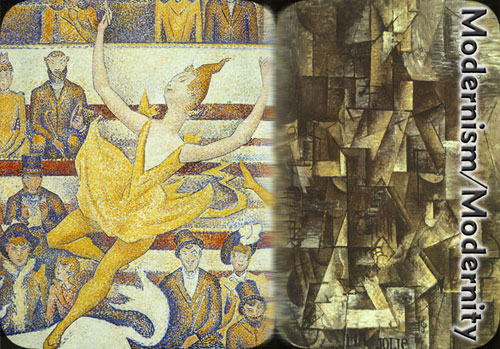
This course examines a remarkable period in French art during which avant-garde painters were especially attentive to ongoing developments in modern visual culture. Publicity posters; political caricature; photography; newspaper and magazine illustrations: these are among the wide variety of extra-artistic materials from which Parisian painters drew at precisely the moment when painting itself seemed poised to destroy its most fundamental pictorial and thematic conventions. Recent histories of modernism have understandably focused on the relationship between avant-garde art and emerging forms of mass culture, and the work of painters like Manet, Degas, Seurat, Toulouse-Lautrec, Picasso, Bracque, and Duchamp has accordingly spawned interpretive systems in which "high art" operates in negative relationship to a flourishing commodities culture.
Our objective is to review these interpretive models, and to wonder about alternative understandings of the ongoing exchanges from 1871 to 1914 between painting and mass culture. What, for example, is the effect of such exchanges on presumed hierarchical distinctions between "high" and "low"? How are we to account for the persistence of these distinctions in the face of artworks that seek to destabilize such cultural hierarchies? What are we to make of the intersections between increasingly "radical" artistic practices and revolutionary political movements that sought to overthrow the reign of state-sponsored capitalism? And how, finally, do we address the apparent complicity of avant-garde art with the larger effects of commodification. These are questions that put considerable pressure on modernism's preferred narratives, and they demand a thorough understanding of the period between the Paris Commune and the First World War. They also demand close, face-to-face analyses of a remarkable selection of paintings on display in any number of Parisian museums.
Site visits include the Musée d'Orsay, the Centre Georges Pompidou, the Musée Marmotton, the Musée d'Art moderne de la Ville de Paris, the Musée Picasso, and the Musée de l'Orangerie.
Note: this is a three-credit, 300-level course. For concentrators and minors in History of Art, it fulfills the following distributive requirements: Geography→Europe; Time Period→Modern/Contemporary.